When I have painted plastic Gauls I have often painted the horn as each unit seems to get one as a sort of ancient example of a Napoleonic drummer. I have always wondered what they sounded like and here it is:

Showing posts with label Caesarian Gallic. Show all posts
Showing posts with label Caesarian Gallic. Show all posts
Thursday, 15 June 2017
What did an ancient Gallic Carnyx sound like?
When I have painted plastic Gauls I have often painted the horn as each unit seems to get one as a sort of ancient example of a Napoleonic drummer. I have always wondered what they sounded like and here it is:

Tuesday, 3 May 2011
Conclusion


The pictures above are the conclusion of the battle of Plexatia. The reason why I have not put them in any order or given any further explanation is because the rules let us down with some bizarre results. The rules were “Macedon and Rome” by Computer Strategies.
Given the disheartening result on day two, I’m surprised that the new gamers I was playing with actually enjoyed themselves but they did, so there was a silver lining to this cloud.
Day one was quite normal – both sides threw their skirmishers and cavalry forward while the main warbands or cohorts advanced. Day one was entirely taken up by this skirmishing (with little casualties) and, by the end of the day (wargaming day – i.e. by about move 9) the four regiments of the Gallic Sotiates force had generally gained the upper hand against their enemies.
Day two was going to be the main event. The warbands were going to charge the cohorts and the battle would be resolved by these ‘serious’ units. Then things started to go pear-shaped. The first warband/cohort melee threw up a weird results – BOTH units were destroyed, so the computer said. No winners, both losers, both units wiped out! Weird we all shouted. No push backs.
Maybe this was a freak result. We tried another pair of units and both were destroyed again. By now I realised that these computer rules had a serious flaw or maybe more than just one. Lastly, we threw the 600 Gallic Soldurii (Chieftain’s personal guard) in against a Thracian unit that was already looking dodgy and was down to half strength. The Soldurii were fresh and in fine shape. Guess what! The Soldurii were destroyed. At that point we gave up.
I wrote to Clinton, the writer of the software, and to quote part of his email “I can only guess that the problem was something local on your PC”. Not very satisfactory but he did attach all the latest software upgrades so in the next few months I’ll replay some of the melees and see what happens. If they work, then that will be great and we will continue to use them. If not, the bin seems like the appropriate place for them.
Onwards and upwards! New things soon.
Sunday, 17 April 2011


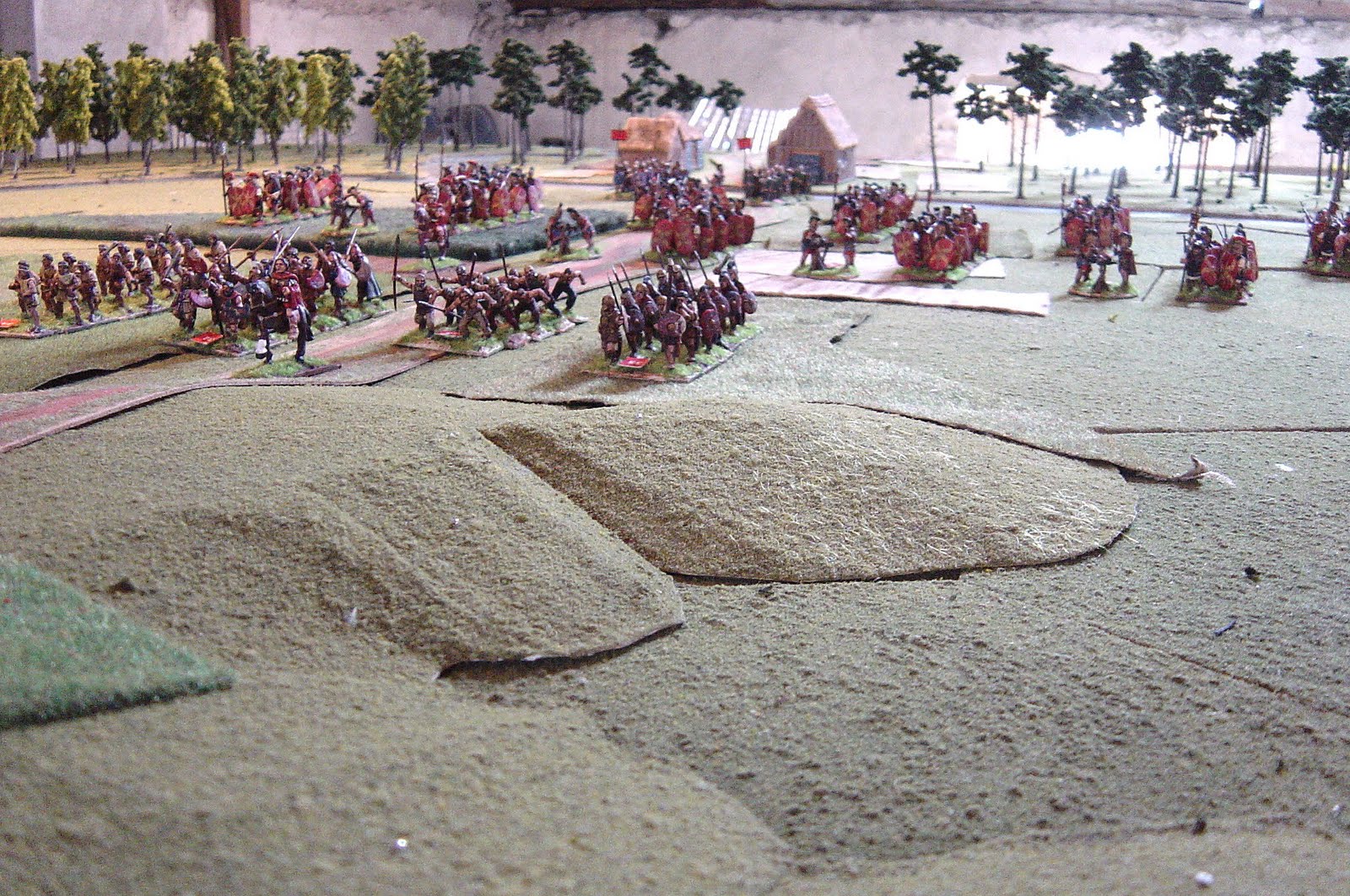


Battle of Plexatia 56BC - Preview 1


We are fighting this fictional battle down the length of the table - 23 feet of it. Crassus has led his 7th Legion, with assorted light infantry and cavalry allies, over the ford (at the River Garonne)
which is located by a friendly Aedui village called Plexatia.
Adcantuannus, the chief of the Sotiates tribe, has heard of the Roman advance on his territory and has moved his entire army of 11,000 men to the ford in the hope of catching them crossing. He has arrived too late and must fight here.
I'll post some more detailed pre-battle pictures. The game will be fought on Tuesday/Wednesday of next week and I'll do a battle report at the end.
Friday, 26 November 2010
Hordes of Gauls


The Roman Army for the invasion of Aquitania is finished. The Gallic army is almost finished – all that remains are some slingers and archers (Old Glory) which are rather uninspiring figures and which I will finish soon. These warbands are based slightly wider than usual to reflect the fact that they are hill tribesmen with the ability to move fast in a looser order.
This post is about the five warbands. I was uncertain as to what I should call them and in the end I have given them names after their standards. It’s not an entirely satisfactory solution and I would rather have named them after locales but most names have changed significantly and a place called, for example, Nerac (a nearby town) was probably not called Nerac two thousand years ago. There is a nearby town called Eauze and that was where an allied tribe called the Elusates was located but that is the only tribal name I have been able to track down – besides the Sotiates of course.
There is a temptation, reinforced by terms like ‘warband’, to consider Gauls to be barbarians in comparison to their sophisticated and sometimes effete Roman neighbours. But this is misleading on a number of levels.
Gallic society was surprisingly sophisticated. It traded throughout the Mediterranean, both importing and exporting and it farmed sufficiently well enough to feed a growing population. The fundamental unit of Gallic politics was the tribe, which itself consisted of one or more of what Caesar called pagi. Each tribe had a council of elders, and initially a king. Later, the executive was an annually-elected magistrate.
The tribal groups, or pagi, were organized into larger super-tribal groups the Romans called civitates. The Sotiates were a pagi within the civitates of the Aquitani but they may also have been a civitates themselves with lesser tribes within their collective. Although the tribes were moderately stable political entities, Gaul as a whole tended to be politically divided, there being virtually no unity among the various tribes. Caesar divided Gaul into three ethnic groups: the Belgae in the north (roughly between the Rhine and the Seine rivers), the Celts in the center and the Aquitani in the southwest and the first two spent much of their energies opposing the expansion of the German tribes into Gaul.
The Aquitani had the luxory of being distant from the German threat and their focus lay to the south of the Pyrenees. They were Celto-Iberians and as Crassus’s campaign continued after the defeat of the Sotiates, the remaining Aquitani pagi called for, and received, help from Iberians who had helped Sertorius in his rebellion against Rome.
Another intriguing facet of Gallic life was religion and the practice of the Druids. The druids presided over human or animal sacrifices that were made in wooded groves or rude temples. They also appear to have held the responsibility for preserving the annual agricultural calendar and instigating seasonal festivals which corresponding to key points of the lunar-solar calendar. The religious practices of druids were syncretic and borrowed from earlier pagan traditions, especially of ancient Britain. Julius Caesar mentions in his Gallic Wars that those Celts who wanted to make a close study of druidism went to Britain to do so. There is no certainty concerning the origin of the druids, but it is clear that they vehemently guarded the secrets of their order and held sway over the people of Gaul. Indeed they claimed the right to determine questions of war and peace, and thereby held an "international" status. In addition, the Druids monitored the religion of ordinary Gauls and were in charge of educating the aristocracy. They also practiced a form of excommunication from the assembly of worshipers, which in ancient Gaul meant a separation from secular society as well. Thus the Druids were an important part of Gallic society. The nearly complete and mysterious disappearance of the Celtic language from most of the territorial lands of ancient Gaul, with the exception of Brittany, France, can be attributed to the fact that Celtic druids refused to allow the Celtic oral literature or traditional wisdom to be committed to the written letter. They also encouraged the practice of of headhunting as the head was believed to house a person's soul.
The other thing that is worth noting is that the Romans were hard as nails. Under Caesar their ruthlessness was quite a shock to the Gauls. Caesar’s war was a war of conquest not a war of retribution. By the time the Gallic tribes had united under the chief of the Arverni tribe, Vercingetorix, the game was largely over. As many as a million people (probably 1 in 5 of the Gauls) died, another million were enslaved, 300 tribes were subjugated and 800 cities were destroyed during the Gallic Wars . The entire population of the city of Avaricum (modern day Bourges) (40,000 in all) were slaughtered. During Julius Caesar's campaign against the Helvetii (present-day Switzerland) approximately 60% of the tribe was destroyed, and another 20% was taken into slavery.
I take no credit for the painting of these figures as they have marched in from overseas. But I had to sort out all the shields (if I never do another transfer it will be too soon!), paint them with Armypainter to give them that dirty, muddy look and then base them. Figures are mostly from the excellent Warlord Games.
Saturday, 23 October 2010
Adcantuannus


I knew when I saw this vignette on Foundry's website (GL15) a few months back that I had to buy it to represent Adcantuannus, my Gallic chieftain, despite it’s completely outrageous price. It’s very cartoon-comic like and the sculptor (the same one who did Foundry’s SYW French and British) has certain traits that I recognized when the pack arrived – like, for example, sausage fingers. But, besides these minor things, I like the overall effect and the story it tells. Clearly our chieftain is fond of his capon as well as wine from the Republic (the aristocracy of Gaul had developed a taste for Roman wine by this time) and his four exhausted shield bearers are groaning under their portly load.
Nobody knows what Adcantuannus looked like and I have chosen to make him an old man beyond his prime and quite possibly too old to mount a horse which accounts for this method of transportation. The question is, on the wargames table, should he be stationary or allowed to move? I suspect that if a cohort charged in their direction the shield bearers would very unceremoniously dump their august passenger and grab weapons or run for it.
But on the other hand, if the old boy stood up (perhaps not an easy thing to do) he’d have a better view of the battlefield than on a horse. A minus for mobility and a plus for the improved view?
Wednesday, 20 October 2010
Spanish Caetrati


Not castrati, as someone on TMP recently said, these are caetrati, or Spanish light infantry hired by Crassus to join his army for the invasion of Aquitania.
Figures are by Crusader, shield transfers by LBM studios and Army painter is by, well, Armypainter!
Monday, 18 October 2010
Spanish slingers


These are Crusader figures for my Caesarian Roman army. As the Roman army of this period did not have auxilia they needed to hire light infantry from whomsoever. These slingers have been supplied to Crassus by a nearby friendly Spanish tribe and they will shortly be joined by another group armed with javelins and shields.
These figures were given the quick painting job that involved using Army Painter. They were black undercoated and every colour, except the flesh, was a single tone. The weathered look comes from the Army Painter and this product, which I cannot recommend highly enough, has made this process speedy and enjoyable.
October is normally a month for tidying up my painting desk so I’ve painted quite a variety of figures which you will see over the next few days.
Sunday, 3 October 2010
Eporedorix


Eporedorix commands the infantry in the Sotiate army. He is a strange figure because he comes from two manufacturers - from the waist up he is, I think, from Warlord Games. A 'freebie', who has been sitting legless in a drawer, he has yearned for completion! The bottom half is an old Foundry figure (late Roman Officer but 'late' in more than one sense). Put the two together and he is totally unique.
Monday, 27 September 2010
Correos and the last of the Gallic cavalry


Correos commands the four units of Gallic cavalry in the Sotiate army. He is a 1st Corps figure. The last of the cavalry units is actually a packet of plastic Germans from Wargames Factory and difference between the Germans and the Gauls is small - the Germans have bare feet, different heads, command and shields but otherwise can easily be used as Gauls. I have changed most of the heads as well as shields but otherwise these serve perfectly well as Gauls.
So all the cavalry (a total of six Gallic regiments) for Crassus's invasion are ready and the plan is to finish both these armies by the yearend as well as paint up some Napoleonic units as well. The first half of next year will see a return to the SYW/WAS project.
Later on this week I'll try to post pictures of all this cavalry on the table.
Tuesday, 21 September 2010
Gallic cavalry melange


This is the third Sotiate cavalry unit and, as I explained in my last post, I have used surplus Wargames Factory plastic figures on the new Aventine horses.
So here, to recap, are metal Aventine horses with Wargames Factory plastic riders and they are mixed up further as quite a few have metal heads from Warlord Games! I suppose this is one way to use up those surplus bits and pieces.
The Sotiates will have a total of four cavalry units to oppose the two units of Gallic cavalry in Roman service so I have just one more to paint. I’m not much enjoying painting Gauls which is why I have sent 120 infantry off to ‘another place’ to be painted so, when I have finished this last cavalry unit, I just have to sit down and force myself to apply the transfers to over 100 shields. But the end of the tunnel is in sight for these armies and I can see them being ready by the end of the year.
Plus the big bonus is that these armies easily morph into armies for the Punic wars – something I have always wanted to do – and which I will discuss in greater detail later.
Monday, 13 September 2010
New Aventine Roman officers and more Sotiates cavalry


Aventine is not a company I have bought from before but I like the sculpts and so I thought I'd buy some of their new Republican Roman officers as well as some horses, that they sell separately - more on those later. I'd like to recommend these as beautiful figures.
The top picture shows the three together and they cost £10.
The second picture shows the army’s second in command - Legatus Tiberius Cornelius and he is also the commanding officer of the VII legion.
The next senior officer is Praefectus Equitum Decimus Balbus, who commands the cavalry and he shows his Spanish roots by virtue of the falcata he is carrying. I’m sure I can remember from Colleen McCulloch’s books that the Balbus family were Caesar’s bankers and that they originated in Gades (Cadiz). Perhaps a debt is being paid off here.
The third officer is the most junior and he is Tribunus augusticlavius Lucinius Nexus. He commands the two cohorts of recruited veterans as well as the light infantry.
Lastly, there is another unit of Wargames Factory’s Celtic/Gallic cavalry. I’ve reviewed these before and was less than thrilled by them then. I still find it very hard to give them a decent paint job and I’m using them because they were cheap, which, in my book, is as good a reason as any. Now the odd thing about Wargames Factory’s packaging is that you will have a lot of surplus riders left over when you have used a box that contains 12 complete figures. And, even though they sell separate horses, that will not solve the problem as they don’t sell separate saddles. So, in the spirit of using everything I have bought, I looked around for someone who would sell separate ancients horses with saddles on them. Bingo – Aventine! At £5 for three horses they are not cheap (and indeed you could buy another box of complete Wargames Factory cavalry for the price of the 12 horses I bought) but at least I have the satisfaction (minor thought it is) of having used up all or most of the bits I have previously bought. Needless to say I’m not entirely convinced of the logic of this but you will see the results soon. Plastic figures on metal horses.
Monday, 30 August 2010
Adcantuannus’s Soldurii


Gaius Julius Caesar’s description of the soldurii is as follows: “And while the attention of our men is engaged in that matter [the attack on the Oppidum of the Sotiates], in another part Adcantuannus, who held the chief command, with 600 devoted followers whom they call soldurii (the conditions of whose association are these, - that they enjoy all the conveniences of life with those to whose friendship they have devoted themselves: if any thing calamitous happen to them, either they endure the same destiny together with them, or commit suicide: nor hitherto, in the, memory of men, has there been found any one who, upon his being slain to whose friendship he had devoted himself, refused to die); Adcantuannus, [I say] endeavoring to make a sally with these, when our soldiers had rushed together to arms, upon a shout being raised at that part of the fortification, and a fierce battle had been fought there, was driven back into the town, yet he obtained from Crassus [the indulgence] that he should enjoy the same terms of surrender [as the other inhabitants]. “
When I placed my last order with Wargames Factory (great service, by the way!) they sent me some freebies – enough to make 16 Saxons and, not really needing to start another period, I put them aside to use as Gauls. Seems unlikely, I hear you say, as they are separated by about 1000 years of history but you judge for yourself. Given Gallic heads and shields, I reckon they look okay. These then will be Adcantuannus’s personal bodyguard and it will be interesting to see how many fulfill their contractual obligations to their boss!
On the subject of my Gallic army, I have been giving thought to variable move distances for warbands. The main strength of such an army, against the Romans for example, seems to me their great speed over poor as well as good terrain. The rules I plan to use are another Computer set “Macedon, Rome and Hellas” by Computer Strategies, and I’m fairly familiar with them having used them ten years ago. The move distances in the accompanying booklet state that HI and MI move 150 paces and Open MI/HI move 200 paces (I’m using the groundscale of 1 mm = 1 pace). I’m planning to rate all my warbands as Open MI and giving them one (d6) of extra variable compulsory movement with each pip giving an extra 10 paces. So their movement could be between 210 paces and 260 paces and this will mean that warbands will hit the Romans in an uncoordinated manner, which I think is fair.
The other thing I’d like to play around with is the ability of the Gallic C-in-C to hold back his warbands from instantly charging the enemy at sight. The better his skill, the more likely he could hold his forces back.
These ideas will need playing out on the table. Any thoughts most welcome.
Subscribe to:
Posts (Atom)