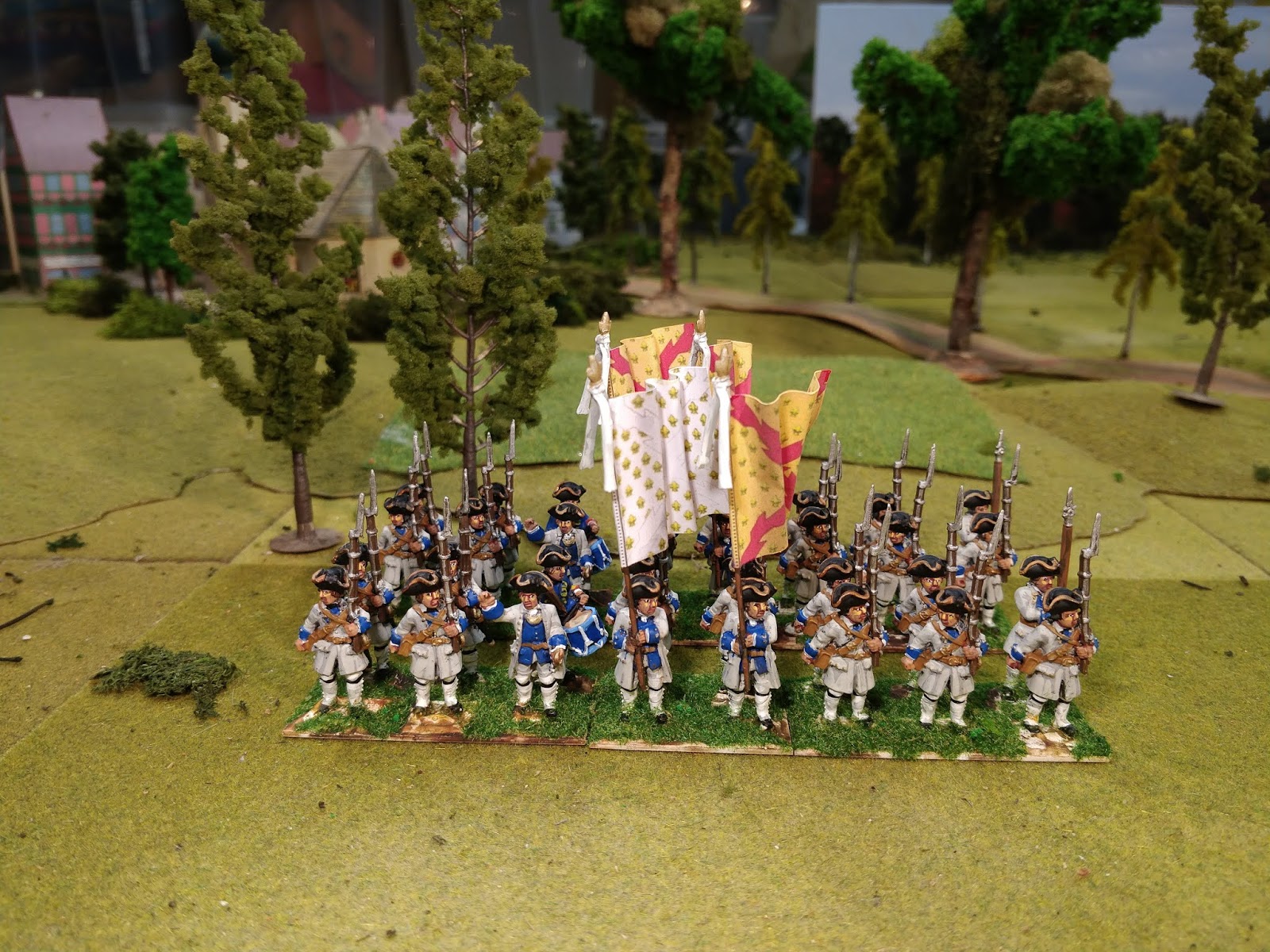
Raised
in 1756 by Guillaume
Henri, Prince of Nassau-Saarbruck, it was initially named Volontaires
de Nassau-Saarbruck
and consisted of two squadrons. In 1758 it was increased in strength
to 4 squadrons (about 600 men) and was placed on the official French
establishment.
Wednesday, 30 October 2019
28mm SYW French: IR59 Royal Comtois
This
regiment was raised in 1674 by the Marquis de Listenois and it became
a Royal regiment in 1685. Besides being involved in the capture of
Minorca at the beginning of the SYW the regiment does not appear to
have participated in any major battles. But during the WAS it was
heavily involved in the invasion of Bohemia.
The
unusual flags show a Burgundian cross on an aurore background.
Friday, 18 October 2019
28mm SYW French: Swiss Regiment Eptingen
This
Regiment, which appears to have been unnumbered (although IR122 seems
appropriate), was raised in 1758 from the Basel area although most of
the officers came from Alsace, perhaps by virtue of their
bilingualism.
The
other thing that is unusual is the yellow facings. The other 10 Swiss
regiments in French service (as well as the Swiss Guards) had blue
facings and Kronoskaf suggests that in 1761/2 the facings changed to
blue. Meanwhile, for a few short years, the regiment had these
striking yellow facings. Figures are from Crusader.
Wednesday, 9 October 2019
28mm SYW French: IR 3 Navarre
This
was a 4 battalion regiment, formed in 1558 as Garde
du Roi de Navarre, with
an admirable service history which is available on Kronoskaf.
Sunday, 29 September 2019
28mm SYW French: IR 57 Cossé Brissac
Kronoskaf
has a strange comment concerning this regiment: “In
1757, the regiment was considered as cheerful, noisy but otherwise
well behaved.” I am not sure what this means – does it mean that
it was reliable in battle or that it was somewhat rowdy? It certainly
had a rough time at Rossbach despite it's colourful flags.
Thursday, 5 September 2019
40mm WAS/SYW IR22 Roth 1st Battalion
In my previous post I
said I was going to be painting an unusual Austrian Regiment and here
it is.
This is taken from
Kronoskaf: “For the moment we have very few information on the
uniform in 1756, at the outbreak of the war. Most of our references
describe the uniform in 1762. However, Muhsfeldt and Schirmer mention
that, in 1756-57, the coat was white lined red (therefore red
turn-backs), the distinctive colour was red and the waistcoat and
breeches were blue.N.B.: in his work, Gustav Ritter Hubka, mentions
that, from 1714 till 1767, the uniform of this regiment had ponceau
red lapels and cuffs, and yellow buttons. Furthermore, from 1757 to
1767, he mentions a blue waistcoat and blue turn-backs with white
breeches. Even though, this description seems very surprising, it
must be pointed out that Hubka has been Oberlieutenant and
Regiments-Adjutant in this regiment, so he might have had access to
privileged sources.”
I am going with the colour scheme of Gustav Ritter
Hubka so white coat, blue waistcoat and turnbacks. White trousers.
Red cuffs and lapels.
As for the flags, they were probably not used by
this regiment which spent most of the WAS in Italy and was not
present at Hohenfriedberg. But I think the red-white stripes
perfectly match this regiment. One of the problems of painting the
Austrians for the WAS is not the number of strange and unusual
designs (which I rather like actually) but rather attributing them
with any certainty to any particular regiment.
The second battalion and grenadiers will follow
later this year. Figures are from Sash & Sabre.
28mm SYW French: IR 42 Rouergue
This regiment had hard fights at both Minden and
Warburg. At the latter, where it was initially kept in reserve behind
the centre, it vainly tried to rescue the Bourbonnais regiment,
losing about 800 men. Out of the 49 officers present, 33 were killed
or wounded.
Subscribe to:
Posts (Atom)